

MIO: Memories in Orbit

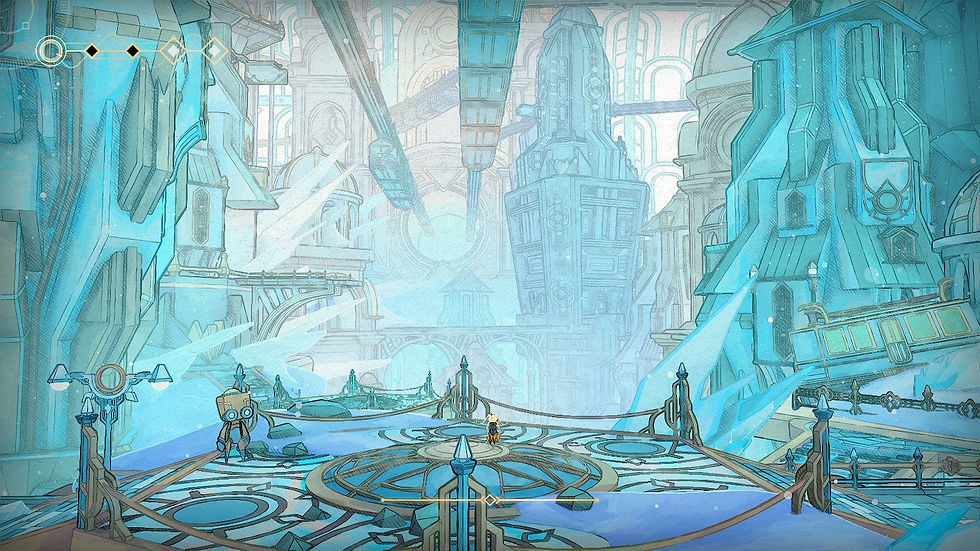
There’s not a lot of video games whose titles are an abbreviation. Followed by colon and the full name of said abbreviation. Pretty sure this joke has been made before by a dozen reviewers, but it’s odd such names exist. I assume the lead heads in charge of such projects looked at the names, the guy who thought of it, stared back at the name, took a deep breath, and confidently said “ok”. What usually pops to mind for me is FTL: Faster Than Light, and for those not in touch with the indie scene they probably think of DMC: Devil May Cry. All the Devil May Cry fans rave about the 2013 reboot, and by that I mean raise bloody pitchforks and chase anyone who likes it away. The same goes for anyone who enjoys the anime, but that statement seems out of the blue. Well here’s another game to throw into the club of abbreviated titles, MIO: Memories in Orbit. Small indie metroidvania that came out earlier this year and I’ve been keeping a close eye on. Mainly because I didn’t hear much about it until before release, and when it came out the indie content creators I follow started praising it. I looked up a trailer, looked cool, and wishlisted.
Not gonna spend the intro re-explaining my love for metroidvanias, because I’ve done it enough. A new one comes out, I play it, love it, compare it to what came before, and praise it some more for what it’s trying to be. In the case of MIO the inspirations are very clear. A huge mixture of Hollow Knight, a little bit of the Ori games squeezed in, and topped with cute sci-fi robots that get to experience the highs and lows of existentialism. Love myself some good sci-fi pondering about the universe in bed. You all know I love the Hollow Knight games. Silksong was supposed to be my game of the year in 2025 before it was overtaken by Hades 2. As for the Ori games my mind never really thought about them as time moved on. Mainly due to having played numerous metroidvanias over the years, but also because the only thing that sticks out to me about Ori is the art direction. As for gameplay it was good at most, and there’s a lot of genre entries doing a part Ori does but better. Games with more fluid movement, flexible combat, and mechanics to go experiment with. Ori is good, but my praise for those games hasn’t retrospectively aged well.
A small fear I had going into MIO: Memories in Orbit, because a lot of the folks who suggested it to me said it’s like Hollow Knight and Ori but science fiction. Saying their favorite part were the visuals and only highlighting that aspect of the game. Still I was intrigued to see what MIO was trying to do, and after spending the last few days gliding through its world I can safely say it’s a fantastic metroidvania. With all the elements that make these games good and not choosing style over substance. MIO: Memories in Orbit is gonna go down as one of the best metroidvanias of the year. There’s a lot this game does very well and moments it surprised me. Egging my little fingers to press on to see what’ll happen next. MIO is absolutely worth picking up if you adore these kinds of games. There are faults with it though. Design choices I find really divisive or not able to defend even as someone who enjoys challenging experiences. Decisions that a majority of players have pointed out across the game’s twelve or so hour runtime. MIO will either be great or good enough depending on who you are, but for me it was excellent. Enough to take time to write this review. (Just a few hours before Mina The Hollower comes out. I’m good with timing.) Today let’s discuss MIO: Memories in Orbit and why it may deserve your attention.
Story

The earth has finally died after several years of terraforming, pollution, and every single species aside from mankind having been driven to extinction. The solution is to fly into space. As almost every single science fiction story has taught us that space is great. Aside from Halo, Warhammer, Alien, Prey, Duskers, The Alters, and all the other ones. What remained of mankind built a giant ass vessel. Containing regions such as a city they could live in, ever growing forestry, a sky high observatory, factory, and research labs. Aboard this ship were also robots, and these robots were put in charge of taking care of the humans and locating a new planet they could live on. A goal that drove the robots to keep living even when all the humans aboard the vessel died. So the goal didn’t go as smoothly as everyone thought. Some humans even predicted this would happen and decided to create a special legion of machines named the Voices. A knowledgeable leading head would have their minds uploaded into the machines so they could guide others around them. This idea worked and thanks to technology they developed they could still bring humanity back even when they were long gone. Thanks to their leftover cells and incubation processes.
Hundreds of years pass and sadly the machines don’t manage to locate a single livable planet. As they are all either toxic, dangerous, or contain no means of planting evergrowth. One of the five Voices, it being the Heart, has grown weak and is slowly powering down. Without the Heart the connection with the other Voices have been severed. Leading to their slow demise, or driven to insanity due to isolation. In times like these a last ditch effort is put into effect. Smaller machines woke up to navigate the vessel and reconnect the Voices. You are one of these small machines, Mio, and you are conceived into the world with one purpose and one purpose only. Embark on a grand mission, put things back together, and give the remaining machines the hope that one day you will find a habitable place to settle.
Gameplay

You know the drill my fellow reader. Explore a vast world with interconnected pathways, secrets, and environmental challenges to overcome. Whether it be in the form of platforming or the rogue machines gone haywire. Unlock upgrades that allow you explore more bits of the world. Try to figure out where to go, and die and die again against boss fights who’ll test your sanity. MIO has a bit of soulslike DNA packed in and honestly I would consider it one. Everytime you defeat an enemy you get a resource called Nacre, and it’s basically the Souls of this game. You lose them when you die, but unlike Hollow Knight or Nine Sols where there’s a way to recover the resource you just lost here in MIO there isn’t. They are gone forever and you have to just have to live with the mistake, but that isn’t to say there’s no way to save your Nacre. Scattered through the world are converters, and using them you can transform liquid Nacre into a crystalized form. That way when you die the Nacre isn’t lost. You get to keep it sorta like having a debit card, and this can be spent at shops the same way you can spend liquidized Nacre. MIO also takes an interesting approach to healing. Most soulslike games give you healing charges that replenish at rest points, or a resource you can loot off enemies but are one use. MIO has none of that, and instead goes for healing fountains. Which you must spend Nacre at to recover.
These are design decisions I find quite conflicting even as someone who likes the challenge these soulslike games have to offer. There’s even one more, but we’ll touch upon it more by the end. Traversal in MIO is quite satisfying thankfully. Once you unlock a good handful of the abilities, the world becomes fun to explore and it’s satisfying when you uncover secrets and new paths. It puts exploration and world design first over combat, and a vast majority of stuff you find while exploring the humongous world is quite useful. Coating fragments that when four are found you gain an extra health point. Perks you can equip that grant Mio buffs, but utilize slots to fit. You can upgrade the perk slots, or even equip decomposed perks to earn more slots but be given one of many disadvantages. Such as healing fountains no longer being able to heal, or get less Nacre from defeated foes. Your abilities include a grapple to zip toward airbound points, gliding across long distances, spider-like tendrils to crawl on surfaces, and a dodge that when done right before an attack hits you avoid it completely. It’s sorta like parrying in Clair Obscur or Furi. A skill you want to get good at if you plan to overcome any combat challenges.
What makes MIO a bit unique is that if you manage to successfully dodge, or smack an enemy or object while midair your energy gets refilled. Energy being what’s needed to use half your skills. Run out of energy and you gotta wait a few milliseconds to use again, which you don’t want as both platforming and combat challenges tend to ramp up quickly. Knowing when to smack items in the air is fun and reminds me of cloud stepping in The Messenger. Chaining different abilities so you can get to where you need to be. Open shortcuts to cut down backtracking and find fallen Overseers so they may return to checkpoints so you can fast travel. Every once in a while you’re locked in a room and either fight waves of foes or a boss. Half of these being endurance tests, so again all you can do is get good or come somewhat prepared. Your ultimate goal is to locate the five Voices so you can reach the Heart, and that’ll take awhile. As the most simple way forward will often be locked off forcing you to find new skills or take an alternate path you probably did not think of. MIO despite a couple frustrating aspects is a game that kept me quite engaged. Let’s just hope you may reach the Heart and give it the motivation to keep moving.
Thoughts

As I said during the intro, MIO: Memories in Orbit will either be a game you really enjoy or get frustrated halfway through due to some questionable design choices. Last year there were several debates about Hollow Knight: Silksong and its difficulty. How some aspects of the game felt like they were annoying or designed to work harshly against you. Losing two health points when you are hit by bosses or environmental hazards, certain runbacks to fights, special abilities needing either a special finite resource or silk that you also need for healing. All of this spread across one gigantic world that may take 40 hours to beat if you’re aiming for the true ending like me. Unlike most people I didn’t really mind it much. I adored the game for what it was, and when I got a bit frustrated I took breaks. Growing up you realize taking breaks is one the most helpful things you can do. As it teaches time management & not inducing burnout through cranking away. I loved Silksong because its world feels natural and enjoyable to explore. A sense of immersion hard to obtain with most 2D games. Knowing when to plot moments of relief and excitement. However, I can’t deny the fact the game isn’t for everyone. That not every player can meet its high level of demand. Especially when not everyone has five to six hours per day to pump into games. I have a few friends who consider the first Hollow Knight better, and honestly I agree.
Why am I bringing this info up despite my Silksong coverage having been written and released in September last year? Well it’s because some of the issues I have with MIO are the exact same as the folks who had problems with Silksong. Controversial design choices and level of demand that even I can’t justify. The vast majority of the time I understand why bits of annoyance are put into video games. I understand why resources are strict in survival horror games. I understand why combat might not be flexible in games where you’re just a dude and not some anime swordsmen who can juggle blades like clown pins. Memories in Orbit has become one of few games where it’s design is just kind of bullsh*t sometimes. A shame, because the aspects I love about MIO are really great! This game is a soulslike, but doesn’t have conventional means of healing. You have to find those healing fountains, and they require Nacre to work. Resources you either crystalized, lost, or don’t have enough of as you tried ignoring enemies to get back to where you were. This makes bosses and combat rooms a bit of a core to learn. Yes, they are fun but there’s the fear you can only take so many hits before death. Whereas in Hollow Knight you knew that if you played well you could heal, or in Nine Sols you consider when to spend one a charge.
This is made much worse with what I think is the game’s worse design choice. Points in the story where your body is breaking down and you lose one of your health points. There is no way to fix them. They are gone forever and you gotta deal with this punishment. I cannot defend this. Even if the story and lore is good. The joy of a metroidvania is getting stronger during your journey, and the game ramps up difficulty to match your evolving skillset and mechanics. Walking in the opposite direction doesn’t make you feel better. Heck, it may even make you feel worse as the health points you unlock feel like replacements for later rather than growing in strength. I’m sure the game only makes you lose so many health points, but if you’re someone who doesn’t explore the world thoroughly you may be limited on how much of this game you can play. As Mio grows weak and you take less hits to die. Then you gotta run back to the boss room, and the runbacks are bad. I didn’t mind them too much in Silksong, but here I do because sometimes there is just nothing between me and the boss room. Whereas in Silksong there was platforming and foes.
That’s my rant about MIO, so now it’s time to talk about the good. Thank god the good parts are great! MIO is really one of those games where the sums are greater than the whole. The combat might be clunky and too demanding at times, but at least the exploration and traversal is fun. The world is intrinsically designed and once you scrape together enough skill upgrades finding all the loose secrets and pathways is satisfying. Picking up perks, coating fragments, attack upgrades, or stumbling upon something you didn’t think was explorable. There is a whole area hiding above the vast vibrant greenhouse region. A space I didn’t think was there, but was thrilled to once I’d poked around enough. A space gleaming into the cosmos as I ascended ever further to what’s left of an observatory. Taking a moment to gaze into the stars and realize how beautiful the universe is despite everything slowly crawling towards its doom. Then continuing right to end up behind the chamber of one of the Voices, and then realizing something even greater about MIO.
Due to the game taking place aboard a space vessel you end up looping back to an area you were at hours earlier. Most metroidvania games have edges and corners to their worlds. Places where you gotta turn back around, because the playspace isn’t any bigger. Memories in Orbit not just looping back around but having an actual story reason as to why this happens is amazing. World design is peak in Memories in Orbit, and I’m surprised how much variation there is among each of the areas. You expect a greenhouse to be mainly green with a couple of flowers. No, it holds dozens of vibrant planets with rivers of neon blue. Reflective trees of bright purple and pink. A butt load of cool summer colors in what I describe as the Steven Universe color pattern. You got to see it to understand. Exploration is genuinely fun and as much as I despise the health system I do think progressing in the world has its own thrills. Carefully making your way through, once in a while considering what you can and cannot handle, figuring out the right path, and inching further into unknown territory. Being rewarded for taking extra time to check spaces. It’s great.
Platforming is fun as harder challenges make use of the mechanics at your disposal. Mixing the different abilities you acquired to hop and glide around. The perk system is unique as if you need more space for perks you can take debuffs to obtain more space. The way currency works is cool despite the frustration of there not being corpses running. Finding a station to bank your Nacre is thrilling, and even if you lose Nacre there are broken stations to find with crystalized Nacre. The exposed loot gives you much more than what you can get from killing enemies at times. The one shop in the game doesn’t get more goods unless you find the shopkeeper's workers, and even if you do they require Old Cores to purchase. A resource you only gain from finding bodies of the larger machines. Further reinforcing that loop of exploring for every potential secret. All of that is done really well and the only complaint I have about world design is occasionally getting lost, but this is expected from metroidvanias at this point and I don’t mind. Gameplay-wise I did love it. If the combat and healing system were reworked I would say the gameplay is near perfect.
MIO isn’t gameplay alone of course. You’ve read a good chunk of my reviews. You know there’s always a part where I discuss the plot & themes. Memories in Orbit is about a lot of things. One such thing being distant memories of the past and how they influence us now. Maybe they’re the reason you keep pushing forward, or maybe they’re what makes you doubtful. The pain of not having one you loved by your side anymore, or expectations weighing down on your shoulders. The fear you’re not living up to them. The thought that what you are doing is pointless and you should give up at some point. Especially since the world of Memories in Orbit is dying. All will cease to exist eventually and you experience this pain. Your body breaking down and reminding you of the eventual coming of the end. Wondering how you’ll be remembered, or if there will be people who want to remember you. All done with this soundtrack of heavenly hymns. One you would hear during the passing of another. Memories in Orbit is a game I recommend despite the whack ass design decision. Even if you do struggle there are assist options like being able to use an endgame perk earlier to help with the healing system, or bosses growing weaker each attempt. If you’re fine with a decent challenge and desire an intriguing world to explore then I strongly recommend picking the game up. I give Memories in Orbit a 9/10 for excellence.


Comments