

Assassin’s Creed: Odyssey - Opening Pandora’s Box


The story of Pandora’s Box is one of unintended bad actions. A human woman discovers a box and within this box is a secret. The box is shiny, looks nice, and as all enticing things are you the holder wants to interact with it. Peep inside and see what is contained, but instead of containing candy or a gold necklace the poor Pandora unleashed a plethora of chaos. All the terrible emotions we experience weekly. Pandora doomed the world across a prolonged period of time. However, within that box there was also hope. Something good to be found within all the bad. Hope was then let out, and with it the drive to keep striving. This to me is what this story is about, but with all Greek tales there are different ways to interpret it. You can see the tale of Pandora about the consequences of curiosity or refusing to listen from others. Pandora didn’t listen and proceeded to open the box.
Assuming no one has made a review/essay using this tale already you may be wondering what any of this has to do with Assassin’s Creed: Odyssey aside from being a myth from Greece? Two reviews ago I discussed Assassin’s Creed 3 and how it was the big starting point for division amongst the fans. The first time Assassin's Creed dipped in quality and made people wonder how this series would be handled. What would Assassin’s Creed turn into and would it be unrecognizable to what it originally was? Could the developers learn from mistakes or repeat them? Were some of these issues predictable back then? Assassin’s Creed is a franchise that is bouncing all over the place. It wants to deviate and try new stuff so the formula doesn’t stagnate, but in doing so they risk alienating their original audience. It switches between evolving & devolving, and you kinda just stop caring after a while. Making a good open world game is hard, and I’m surprised Ubisoft kept it up for this long. Opinions on Assassin’s Creed are one to be argued about, which is certainly what happened with Odyssey when it released eight years ago.
I remember when this game came out. I asked some friends if I should play it since my love for games wasn’t as big as it is now. All of them told me the game sucked and that it’s one of the worst entries in the series, which confused me seeing how a majority of review outlets gave the game glowing reviews. That’s when I stopped listening to review outlets and began listening to a lot of the reviewers I listen to nowadays. Yahtzee Croshaw, the guys at Skill Up, AngryJoe until I realized screaming into a mike doesn’t mean you have personality, etc. Their opinions were a lot different compared to review outlets. Yahtzee ranked it as his third blandest game of 2018, and Joe alongside his close friends said it was close to being mediocre. Skill Up has probably the best review out of them and echoed the biggest critique people were having with open world games at that point. The title of his video was, “Bigger Isn’t Always Better.”
Many gamers were raised to believe that a game with hours of content is always the best. Seven years prior Skyrim changed the world, and while it wasn’t the first open world game it did send a message. Games need to be grand in scope, but while I’m not a big fan of Skyrim this isn’t probably what made the game good. Skyrim was good due to the thrill of adventure. Of being offered smaller journeys amongst the big ones you were a part of. The game allowed you to go anywhere at any time and player discoveries would occasionally net you cool moments or rewards. It had atmosphere & whimsy. A year prior to Assassin’s Creed: Odyssey we got Breath of The Wild, and it redefined what open world games were. Putting exploration over flooding the map with activities. The same year we got Red Dead Redemption 2, which believed taking your time to soak in this setting was more important than being ‘fun’ all the time. Assassin’s Creed: Odyssey did not just struggle to hold up to its contemporaries, but struggled to figure out where it wanted to take the series. It wanted to be a free approach open world action RPG with player choice & consequences. Build on the changes Origins made, but diverge further.
Hence why I’ve avoided Assassin’s Creed for a long time, but then a friend convinced me to play Origins in 2022, and I loved it despite all its problems. Then I played Assassin’s Creed 2 on a whim during 2024 and binged four more of the entries later that year. I’ve quickly become an Assassin’s Creed fan in a time when people are sick of the series. Well I guess being late isn’t always bad, and I chose an interesting time to finally binge more of the buggers. Two reasons; Black Flag got a remake and Christopher Nolan is making tons of money with The Odyssey. My mind has been in a Greek mood lately and it felt right to finally play Assassin’s Creed: Odyssey. Fifty hours later I can say that a majority of the criticisms this game faced were right. With ideas that either feel there or weren’t fully fleshed out due to how much focus was on the scope. The weird thing is that I acknowledge Odyssey is a very flawed game, but I loved my time with it. I’m not saying Odyssey is an underrated masterpiece, because it’s not. If someone told me they hate this game I would understand them. Assassin’s Creed: Odyssey is a messy experience, but for every wrong it manages to impress me in other ways. So today let’s talk lengthily about Assassin’s Creed: Odyssey and the many things it attempted to achieve.
The Open World Experience

2022 was a very interesting point in my life. Not only was I heading into college, but I wanted to test what kinds of reviews I could write. Elden Ring and Horizon Forbidden West came out, and the big craze was on open world design. I played a lot of sandbox games that year, which led to some bizarre statements from me. Not saying I disagree with what I said, because a good chunk of it still holds up. What I’m conflicted with is the belief on how an open world game should be approached. Is there a correct way to make an open world game? Should an open world game be free, give players little direction, and let them solve problems through discovery? Unravel fun for themselves and grow close to this world, or does this carry the risk of struggling to find the fun? Being punished for running into problems they should be facing later than now? Grow frustrated, bored, or tired with a game too quickly. Should an open world game guide and assist you? Pace you in, show you where the fun lies, and tightly focus on the main experience rather than on how much you can mess around? Handhold you and place restrictions on what you can do at once? When you really think about open world games are the hardest to develop. You have to not just think about the gameplay but how the world itself accommodates it. Systems need to clash in different ways, because if not you receive a world that is unreactive to player actions. A world that becomes boring.
You need your world to be worth spending time in. Hence why you go one of two directions when it comes to open world design. Assassin’s Creed for a long time has followed the second. It has a world that is free to run in, but it guides players toward the fun route. Doing missions in a linear fashion. It’s a structure that has worked in the series’ favor, but around Assassin’s Creed 3 is when you start to see it stagnate. Either facing pacing issues, or failing to switch up the type of stuff a player does. Assassin’s Creed had become formulaic, so around Black Flag they started to delve more into exploration. Create a world where the main story path isn’t the only fun thing to do. Not saying previous games didn’t offer fun outside the main story, but you get the idea. They wanted to dabble more into a player finding fun on their own rather than be shown where the fun is. Origins was their biggest attempt to branch away completely. A world that reacts to player decisions and gameplay actions. A world that lets you run in any direction to make discoveries. A big and mostly open-ended world where none of the regions are loaded or was just mainly a city. The game did do that and for a lot of fans it succeeded. Reviving hope for this long running franchise. Yet, you can still see elements of the old formula sticking on from behind. Those aspects of formulaic game design.
Origins had a vast world to explore, but it didn’t let you explore it all at once. They tried making this game an RPG and so regions have levels to them. High leveled enemies could stomp on the player easily, and even if you do manage to acquire powerful gear you couldn’t wield it until you were the same level. An attempt to prevent players growing strong early on like in other RPGS, but doing so leads to restrictive progression. Do one region, then the next, and so on. It prevents players from fully exploring the world easily, and to some people this is bad design. To some at least, because this isn’t new for games. Fallout: New Vegas had areas that would pummel you if you came ill equipped or underleveled. Signaling to players the simplest route wasn’t so easily obtainable, and they’d have to come back later. Then you do and a challenge you may have seen as impossible is now achievable. You teach them taking time to explore and level up will net you better results. I also see this as adding some mystery to what lies ahead. If this is what challenges you now then what will be harder later? Better to come prepared for that too. Origins had a list of conflicting design choices, but I can’t hate what they’re trying to do. The designers want their players to explore the world they delicately crafted, but they don’t want them blasting through every region. The world should be as important as the main story path, because if not it just feels like a big dumb theme park.
Odyssey attempted to expand on this. Create a larger world with more discoveries, activities, side quests, and encounters. The result is a world that many consider too large for its own sake, but it does feel like an attempt was made to improve. Odyssey has a world I enjoyed waltzing through. With colorful landscapes divided up by occasional townships or cities. I haven’t seen a world this bright since the Caribbeans in Black Flag. Just like in Origins you follow a progression path. Go from region to region, but some of the individual regions are as big as let’s say the size of Rome in Brotherhood. You can waste time running around and seeing what side activities wait. There is a complaint to be made on how much Odyssey repeats certain activities as an Ubisoft open world game does. Such as bandit camps, caverns, shipwrecks, ruins, and so on. Most of which have the same goal of killing the captains/leaders, loot treasure chests, burn war supplies, or pick up some items. They traded unique optional objectives past games had in favor of collectathon goals. I’ll admit that does kinda feel like a downgrade, but looking at the type of game Odyssey wants to be it does kind of make sense why they did that. They want players to experiment while doing these activities, and forcing specific goals for completion limits how they approach their activities. The world is just an impressive playspace to me. You can stand on a high peak, gaze into the distance and know it’s an area you can step into. Similar to seeing all of Hyrule in Breath of The Wild.
Cities and vast plains of wilderness are spaced apart well enough so it doesn’t feel like you are walking endless emptiness for miles. Towns are often busy and pay attention well enough to see the different aspects of said towns. The shops, ghettos, temples of worship, political offices, and so on. Harbors where people go off to fish, and islands that even back then had townships. This is the most lived setting Assassin's Creed has had. Yet, the focus can be smaller than Origins at times. With gameplay aspects that feel there for the sake of being there. You have a ship and the ship is used to sail the great sea. The ship is obviously there to switch up your way of traversal in the same way Origins gives you a horse. Aware that on land travel would get annoying, but the ship in Odyssey isn’t a priority like it was in Black Flag. There is a considerable amount of sea activities and adventures to be had, but less than thirty percent of my adventure was spent on the sea. It sucks, because a good chunk of your investments is spent on the ship. There’s a crafting system for weapons and armor, but we’ll get to that issue shortly. The only thing worth spending crafting supplies on is the ship, but my playthrough only saw me upgrade components halfway to the max. You can recruit captains to offer gameplay buffs in ship combat, and some of them are rewards for completing special questlines or making specific choices. Your crew is awesome as they are there to support you every step of the way, but they don’t exist much outside the ship all aside from a few key story characters. This is what I mean when I say there’s stuff to ‘be there’.
Getting back on topic, there are fun side tales to be had apart from the main plot. Quests are big in open world games, and Odyssey is chock full of them. Some are simple ‘go fetch me this or kill them’ quest from people begging for favors. Occasionally you do get interesting tales and I find them memorable. Partially due to how my chosen character Kassandra interacts in funny or enjoyable ways. You have this one questline involving a slave whose brother comes back from the dead as the Kingfisher. Deciding whether or not the brothers reunite, or you punish the evil one. There’s the Daughters of Artemis questline that follows you hunting legendary animals. You ascend their ranks and get a choice on if you want to be their new master. There’s Sokrates' questline where different events open opportunities to lectures on morality and choice. Then you got all the side activities. One of my favorites being fortresses. Massive strongholds you can infiltrate to find good gear or lower a nation’s hold on a region. Offering the most choice on how you tackle a problem. I think this game gives you the most approach compared to previous games. Some restrictions are placed of course. Stealth & combat aren’t the most flexible compared to other games, but compared to previous entries you have choice. As an open world game I think Assassin’s Creed: Odyssey is mostly good. A few problems here and there, but I didn’t get annoyed exploring this world and seeing all it had to show me. It has achieved its goal of connecting you to the world, but what about the other goal?
The Role-Playing Experience

This game is also an RPG, and now we get to discuss the divisive part of these new entries. How an action adventure series became filled with leveling, stats, and grinding. You should know by now that I love RPGs, but there are criticisms on how Assassin’s Creed handles some of the RPG elements. Loot rarity has never been a system I appreciated in video games, and both Origins and Odyssey have a ton of it. With the amount of side content and activities the player can overcome the developers needed a way for the players to always feel rewarded. Looting chests, killing any strong enemy, clearing out an area, or completing side quests always net a bunch of weapons and gear. The problem is not constant gratification, but rather the quality of the rewards you get and how important they are in the longrun. I never liked loot rarity in games, because it means gear never feels special. The game has an upgrade and crafting system where you can improve gear. Engrave special perks you unlock with leveling, but what is the point if within thirty minutes you’ll find stronger armor or weapons? Weapons that contain better engravings that I don’t have to waste crafting materials and money to make!? Breaking one of the big systems of this game & also making it ‘there’ for the sake of being there. Origins had crafting, but instead of putting it toward a ship you mostly don’t use or weapons it designated toward stuff that actually helps your main character. Base melee attack damage, base defense, the amount of arrows you can carry, the stability of aiming, or stealth attack damage. Sure, armor and weapons could raise this but they weren’t the thing mostly determining this. Hunting animals and supplies in Origins is meaningful as you need them. Whereas in Odyssey not only is new gear constantly given, but also supplies. As basic enemies and supplies are scattered about as far as the eye can see. Whereas in Origins you'd have to look carefully.
The mass amounts of gear also means you gotta do a bit of micromanaging every now and then, which can be annoying. The game lets you wield weapons easily with the only requirement being your level number. It’s a shame there’s all these problems with gear and the handling of it. That the game doesn’t really reward you for rocking a specific weapon you may have worked hard to acquire, because as an action RPG it’s pretty great. Going for an active combat loop whereas back in Origins it was defensive & methodical. It’s like jumping from Dark Souls to Bloodborne if you understand what that means. You gotta juggle multiple enemies at once sometimes. Weave between different attacks, and strike when the iron is hot during perfect dodges. The more you hit enemies the higher your energy bar fills up. Allowing you to perform powerful skills that can level the playing field. Rip a shield from an enemy’s arms so they no longer deflect attacks. Kick them away from you to provide distance, or if the environment offers an opportunity then kill the bugger instantly. Ram into foes, apply elemental effects to weapons, unlock combat arts for your weapons, and so on. Odyssey is a game that is aggressive and active, which makes sense for the character you are. The child of a distant Spartan and raised to master tools at your disposal. This is a fun action RPG, but there is a caveat. Enemies can be sponges. Enemies can be massive sponges in fact. With some taking several minutes to kill, and you gotta sit there and stare ridiculously. Wondering why a jackass who was slashed twenty times with an axe twice the size of their body is somehow still alive. The bloat of health pools is a common critique of the game, but if you can get past that design issue then the combat loop here is pretty darn fun.
That doesn’t mean stealth has been abandoned, because you can spec into it if you want. Build variety while not being much is there, and you prioritize which field you want to do more of. Be a jack of all trades, prioritize being a warrior, or sneaky like me. There are even skills for stealth similar to combat like throwing a spear and dealing chain assassinations. Disappearing into thin air, or performing a critical assassination. This one I really like, because essentially it’s a risky take on just stabbing a bloke. It costs an energy bar and you gotta hold the assassination button down. You may run out of energy or risk being seen while doing so, but some enemies require you to do this to kill them instantly. Leading to wonderful payoff when you do so. Every upgrade feels meaningful. I never once saw a skill that doesn’t make sense or add anything like in other games. Yet, it does bring upon a problem in that Odyssey sacrificed a good chunk of simplicity earlier games had. Past games have been about fluidity and how it looks. Less about mechanics and player skill, or at least that’s how I felt. Newer games have traded this for mechanics and understanding of systems, and that’s not good whether you like RPG games or not.
Despite the combat loop being fun I wouldn't say it's the best combat ever. In fact, I would say it’s serviceable enough. It looks and feels clunky at times. You can’t instantly stab some enemies to death like I said. Sometimes an enemy loses a portion of their health even if you max out skills like critical assassination. It leads to situations where an enemy you wanted gone now will alert others. However, I defend some aspects of this. Strong enemies are often labeled captains or shown if you can kill them in one go. Meaning you may want to pick off other dudes first so you can isolate the stronger foes. The same way Dishonored or Metal Gear Solid V had me think about different enemies types and how to deal with them. Rely on distractions, kill from bushes, behind walls, scale the walls, or avoid enemies till later. The action RPG aspects are done well as you unlock new options to tackle problems, and you feel stronger by the end than the start.
However, not all RPGs are just about stats and leveling. To most people RPGs are about choice. The many moral decisions a player makes during play sessions, and Odyssey dabbles into this a bit. It was an area Origins didn’t explore much, so Odyssey attempts to do this both in gameplay & story. Past games had a notoriety system where committing crimes leads to enemies who’d walk past you notice you faster. This was dealt with by tearing down wanted posters and paying others to lower it. This system is fine to be honest. Reversing the consequences of bad actions is easy, but you can respect the idea they were going for. Origins and Odyssey have this really cool system instead. Due to how wide spread the world is you can’t have guards patrolling roads at all times. Instead players will have hunters pursue them, and the higher notoriety is the more hunters that’ll track the player. These hunters may even appear when you’re doing activities.
It means you gotta be aware of the crimes you commit, and what will happen. You can’t just beat on guards while in the open. You can lower notoriety by paying bounties, or hunting the person who hired hunters. They’re usually hidden in camps surrounded by guards, and those people will raise notoriety if you kill them while they or the person who placed your bounty is watching. It’s a choice you always gotta constantly consider. Some people hate the hunter system, but it adds a bit of reactivity to the world and player. However, this is negated by two things. Bounties aren’t hard to pay off, because money you collect can’t really be spent on much else. As the thing most worth investing in and purchasing are the f*cking SHIP UPGRADES. What the f*ck!? Also by the way you pay bounties through opening the map. A lot of stuff is done through menus in fact, which is something I dislike about these RPG games. They had one of the best ideas this series has made to date, and they blew it as they were afraid of how much this frustrates folks.
Aside from this you got the moral story choices and there’s two kinds of story choices. The ones that don’t affect the world much, and the ones that do slightly. This isn’t Baldur’s Gate 3 where helping the tiefling refugees at two different points will ensure their passage to the final area. New Vegas and the many factions you can possibly offend or team up with during the final battle. The choices here are light, because with how big Assassin’s Creed: Odyssey is I can see trying to keep track of them and having your choice intertwined would be difficult. Yet again, not every game needs to be at a player’s throat. Sometimes these small choices can feel impactful, and you do have a few times when they shine through. Earlier I mentioned the Daughters of Artemis, and near the end you gotta decide whether you kill their current leader or not. Killing her makes you their new leader, but refusing makes the group your permanent enemy. Hunting you down till you exit the island they’re on. However, if you romanced the leader like how I did you can avoid killing the leader and aggressing them. Be able to walk away without shedding violence. There’s moments in the main story like being forced to either save a baby from burning or chase a cultist you’re hunting. Chasing the cultist leaves the baby to burn to death, but saving the baby means you lose the cultist. A person you may struggle to find later, and if so she comes back now aided by cultist guards, which leads to a harder encounter. There are choices like this that matter and feel important. Some don’t like whether you sacrifice a bull’s heart to save a little girl, a man’s family, or an old woman. The outcome doesn’t matter or come back to bite you in the ass.
Yet, they tried to make the main story branch off in different ways. One choice being whether you spare your father Nikolaos or not at the start. You’re supposed to battle him for what he did, but I chose the peaceful option. Avoiding a possible boss fight, and getting info I needed. Later on you gotta fight your father’s adoptive son, Stentor, but if you spared Nikolaos he stops the fight from happening. Leading to both of them appearing during the game’s ending scene. This is one of few times where a choice you make intertwines with another, and it’s sad knowing there could’ve been more of this. Ubisoft can make a somewhat compelling choice driven RPG if they wanted to, but are afraid of locking people out of stuff. Similar to Cyberpunk 2077 never fully committing to player consequences, but the difference is that Assassin’s Creed: Odyssey is mostly confident. It experimented with ideas the series hadn’t tried at this point and succeeded in a good chunk of areas. Much like the open world experience I’d say Odyssey is pretty good at being an RPG. Great even, but it’s not excellently executed. It’s held back by not wanting to fully commit, which leads to non-RPG and RPG fans feeling divided.
How Do You Handle Grinding?

This game is really long. Origins was a good thirty or so hour adventure depending on how much of the side content you decided to do, and Odyssey is twenty hours long. Being fifty hours long depending on what content you do rather than how much. It shocked a lot of players how they were able to bloat the runtime further seeing how Origins released just one year prior. Part of the reason why Odyssey is such a long game is due to one reason, and that is grinding. Players level up slower compared to Origins, and Ubisoft even attempted to sell experience point boosters as microtransactions during launch. For players who don’t want to experience much side content & want a runtime similar to Origins. A horrid business practice that hurts a lot of the design, but we need to ask why there’s so much grinding in Odyssey. To understand that we need to ask ourselves about video game runtime. As I mentioned earlier video games, especially Assassin’s Creed, are much bigger now than back then. Assassin’s Creed 2 had to divide cities into maps you load into, and Brotherhood had to shrink the size of its world to create a playspace you can freely run in. Games are made longer to serve as both a technical achievement for what is now achievable, and to serve as a selling point to some companies. Starfield is always the game that comes to mind for me, because the phrase ‘a thousand planets to explore’ is eye-catching. When a game is big for the sake of it.
So now we have a lot of games that are between thirty to eighty hours long, but at the same time is this anything new for video games? Final Fantasy VII came out all the way back in 1997 and it was a forty hour long adventure. Persona 4 released in 2008 and it was fifty hours long. Much of the examples I’m using are RPGs, which Assassin's Creed: Odyssey is trying to be. We still see games whose main appeal is how big they are, and are awarded for this. Baldur’s Gate, Kingdom Come: Deliverance, Red Dead Redemption, the new Zelda games, and so forth. Where it differs is how they respect the player’s time. Optional content was optional content. You either engage with it because you thought it was fun or not. When a game requires you to do optional content so that you may stand a chance against the main story path then that’s not optional content. This is where the grinding problem comes into play, because if you were to really lay out the main story path of Odyssey you realize it’s pretty simple. We did argue earlier though that the devs need a way to get players to explore their world rather than to zoom past everything. Hence why they enforced grinding and leveling up. The highest level my character was by the end was forty-two and the max level is ninety nine. Yet, this probably isn’t achievable to most players as they'll have to transfer over to a new game to obtain this.
Grinding is bad because it inflates runtime, but there are ways to handle grinding well. Octopath is one of my favorite video game series ever, and the most common complaint is how grinding pops up every now and then. This forces you to explore, and along the way you earn points not just for leveling but for character jobs. Allowing you to unlock skills, and during exploration you may find side jobs. Expanding what your character is capable of and opening build variety. The game is letting you experiment with tools, and what I like was that it didn’t stop you from just going into the next chapter instantly. You can and if your party is set up well enough you can kill the next boss even if you’re slightly underleveled. Baldur’s Gate 3 handles grinding in the sense of not getting stronger, but your party needs the right connections and choices to progress. Such as helping the tiefling refugees or siding with the Absolute. You may have strange encounters as you work towards these goals, and while doing them you level up. The game is having fun with you and distracting from the number crunching other games enforce. To me the problem is not grinding and the time that comes with it. The problem is how much of that grinding can you the developer make fun or satisfying to get through? Assassin’s Creed: Odyssey has grinding, but it is not the worst grinding in the world in my opinion. I’d argue it’s done just right considering the type of game they were trying to make. Remember; open world with free approach & choices.
Help out the locals, get to understand, participate in miniature adventures, and make choices that slightly matter every now and then. Dink around and see where your feet end up taking you. I’d face moments where I was having more fun helping small communities versus doing the main plot. Getting lost in the world and setting. We all know what the story of The Odyssey is right? A man struggles to get home and ends up being set on multiple detours instead. If you read the title, Assassin’s Creed: Odyssey, and didn’t expect this then I don’t know what to say. Well I do, as I’m trying to explain my opinions right now. There are moments when it does feel like the game is wasting your time. Such as some of those side quests I mentioned earlier where the goal is, ‘fetch me a thing and I’ll reward you’. There are the repeated activities as well and while I would not say they’re copy pasted they can be repetitive. What I’m trying to say is that I don’t mind all that much Assassin’s Creed: Odyssey being a fifty hour long game. It’s nice to play a game where I can take my time instead of jetting to the end. As much as I enjoy reviewing short games it gets a bit tiring of having to do one every one to two weeks. Afraid of what will happen if I take too long or if I attempt to cover games with long run times. Odyssey is not the most refreshing game in the world. It contains ideas I’m quite familiar with and in some ways I still think Origins is the better game. However, it’s nice to just play a long RPG. A genre I’ve been wanting to delve more into. I don’t expect this essay to perform well, but I hope it’s open a gate for me. That I can cover more RPGs and not feel pressured to write constantly. Maybe I’ll do Persona next. Who knows.
Can A Series Change?

A common statement I hear for the recent RPG entries is that they’re good video games, but not good Assassin’s Creed games. Begging the question about change and if a series should? This is not anything new if you’re part of any popular video game fanbase. The Legend of Zelda turned into an open world series now diverging from the claustrophobic dungeon to dungeon formula the previous entries were. God of War became a heavy action game about crowd control rather than the hack and slash titles it once was. From Software is trying to experiment with multiplayer with Elden Ring: Nightreign and the upcoming Duskbloods. The Resident Evil series does not know what kind of f*cking video games want to be, so there’s that. I’m not arguing that change is a bad thing. In fact, I think change is a good thing every franchise needs to go through in some form. My fear is that if we keep doing what came before then developers risk stagnating. Slowly turning the tried and true formula into… well formulaic. If Zelda had not gone open world and did the dungeon to dungeon structure again like Skyward Sword, which is a game that divided fans for this reason, then I feel like the backlash would’ve been bigger. God of War could have been another hack and slash game, but developers moved on from these titles because there were too many at the time. If the fourth mainline God of War was hack and slash, and tried to tell the story it wanted to tell then there would’ve been a huge conflict in the themes and tone. The type of game Santa Monica dreamt.
I want to see good developers make different types of games. I’m happy that Sucker Punch made Ghost of Tsushima and Ghost of Yotei instead of making Infamous all the time, because that third entry is one of the most forgettable games I’ve ever played. I’m happy Guerilla made Horizon and not Killzone again, because they did that when the series was obviously supposed to end on the third entry. I’m happy Sliksong plays incredibly different from Hollow Knight, and that even though not everyone was happy they experimented. I’m not saying devs shouldn’t be allowed to go back to older series or do the same stuff. 2021 saw Ratchet and Clank return and it may be one of the best examples of how to revive a series. It’s just that artists should be allowed to do new things. Also isn’t it a better idea that they try new stuff and learn how to make it better? As this is what happened with the Assassin’s Creed series. They did so much of the same within a short period that what was fresh quickly turned repetitive. Then they tried going back to the series roots by making Mirage. A game they thought would be praised, but doing this invited a plethora of comparisons to the older games. What Mirage failed to be, replicate, and how much the writing has gone down since the past few games. It’s an example of why doing more of the same kind of game may actually be worse.
They needed to change, but managed to respect and preserve the series’ identity. The same way the new God of War wouldn’t have happened if the past lore wasn’t there to explain why Kratos is loaded on regret. Black Flag followed an outsider rather than a traditional Assassin or soon to become member. How he eventually joins them not just because it’s the right thing to do, but because he himself grew as a person. He wanted to stop hurting everyone around him and use his talents for the better. Origins despite deviating heavily from the past formula is respectful to the series’ lore. Explaining how this order came to be and what they fought for. I have the standing that video game series are allowed to change. They are allowed to deviate so long as their ideas and what the developers want to make is executed well. Yet, there are arguments to be made.
This is an Assassin’s Creed: Odyssey review though, and there are things to say. Mainly how this is the first in the timeline meaning it’s set before Origins establishing the Assassin Order. Instead of Templar you got the Cult of The Kosmos, and you gotta uncover clues on where each member hides. Yet, you don’t need to kill all of them to finish the main story. Your character was raised to be a fighter, so most of their playstyle is ferocity and aggressiveness. There’s one point where the main story tries to introduce elements of myth, and this is the point I walked away ignoring that it happened. The parkour which Assassin’s Creed has built itself upon was traded for the simplest traversal and climbing you can find. It wanted to tell a story about multiple things, but doing so means it lacks focus. Much of this review has argued for the changes and attempts this game has made, but deep down do I think this is a good Assassin’s Creed game? I understand if people do not consider this one. It made multiple sacrifices and changes, has little to do with future games, and I would've much preferred if this was a new property rather than be labeled as such. I think the game would’ve been received better if it had done so, but at the same time and this is the take that’ll piss a bunch of people off, I think this is a good Assassin’s Creed game. As it connects to what the title of this series is, and what these stories have always been about. One’s self stance.
A Story About Many Things
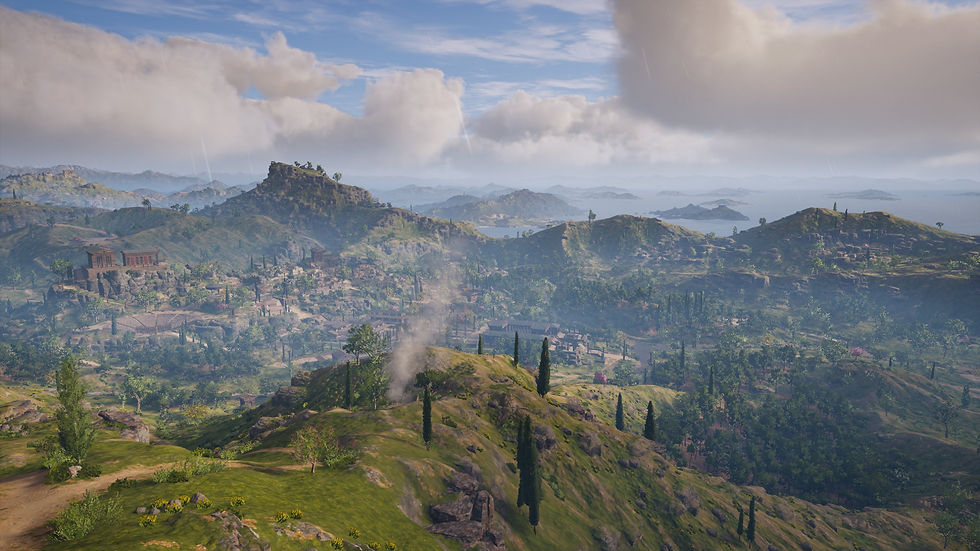
I said that Odyssey is a game about a lot of things. We follow either Alexios and Kassandra. Split apart during the birth of one, and now venturing across the world to find their family. Relocating former family members, helping them with their endeavors, and making sure they come back in safe conditions from the ongoing war between Athens and Sparta. It could’ve just been about this alone, but there’s also other stuff. The Cult of Kosmos who are the Templars of this game, and their influence on the politics of this world. Your origins otherwise who your real father is. How there’s a destiny waiting for you outside of reuniting your family. I like when my games are open for interpretation, but ultimately I want it to be about something. Odyssey being about all of this means it can’t preserve a tight focus. I mention that there are things in this game that feel like they were made to waste time. Despite the cultist hunting and godhood ascendance being labeled as main story quests they aren’t required to beat the game. Just finding your family is all that is needed. They feel there for the sake of being there, and I hate saying that. Seeing how time and effort was most likely put towards making this good.
A lot of people complain the main story is poorly written. That it’s not engaging in the same way the past games were. I’d disagree. The main story itself isn’t what is strong, but the protagonist & all those they encounter. I really love Kassandra as a protagonist. The way she converses with other characters, and there are moments that can be genuinely funny. The game was made by the Quebec studio and previously they made Syndicate. A game that wanted to have a female main character, but couldn’t due to conditions they faced. The main story had twins and some of the story missions forced you to be one or the other. Meaning one either got too much screen time or not enough. However, in that game both had different storylines so that justified some aspects. Odyssey gives you a choice on whether you want to fully play as Kassandra or Alexis. It’s nice to see them make an Assassin’s Creed game where the protag is a female lead. Especially when you consider the setting she is in. A mostly male dominated world where women are either treated poorly, forbidden from engaging in male dominated fields, or are heavily abused. You can serve as an example of what women can be in a setting that wants them silent.
Similar to Syndicate this game tries to be lighthearted and then mostly delivers. Odyssey contains more comedy, but it doesn’t compensate the serious tone and issues for comedy alone. Striking a balance between uplifting moments, emotions, and scenes that are made to get you furious. There’s a dynamic enough cast of characters. While not as heavily engaged in the plot as past games I wouldn’t say they are forgettable. Barnabas, Herodotos, Sokrates, Brasidas, Myrienne, Arkibaldes, Aspasia, and so forth. My complaint with Syndicate was that historical figures felt more like cameos rather than active participants in the story, and Odyssey fixes this. With characters you regularly engage and discuss current matters with. I genuinely like the writing and storytelling of Odyssey. It’s not amazing and certainly isn't on the same level as Black Flag, the Ezio trilogy, or Origins but it’s one of the better stories this series had to offer. A small shame this section isn’t longer for how big the story is, but I do have my closing thoughts.
Departure, Initiation, Return

My coverage is not the greatest in the world. Midway writing this I stumbled on what thoughts to jot there as there were a lot. I could’ve mentioned the cutscene quality at some point, and how they ditched the mocapping. Then explaining why there’s a dip in quality between the animation in Origins and this game. I could’ve mentioned how the game crashed occasionally, because this is a Ubisoft game afterall. There are a lot of reviews and video essays online doing a better job explaining what does and doesn’t work about Assassin’s Creed: Odyssey. The purpose of this review was not just to dissect what people could learn from this game, but why I ultimately liked it despite its flaws. I really love Assassin’s Creed: Odyssey. I have played ten of these games now and if I were to rank Odyssey it would be my fourth favorite. There are a lot of games doing things better than Odyssey. Games with better stealth, combat, exploration, pacing, grinding, progression, choice, and storytelling. Odyssey is a game I can't recommend easily.
There’s so much here that can either be seen as terrible game design or Ubisoft unwilling to learn from their mistakes. Indeed they did as Valhalla was a game that doubled down on the worst aspects of Odyssey. Then they got confused, made Mirage, then Shadows, and remade the best Assassin’s Creed in an attempt to preserve the good faith that was left. I opened this review up by explaining Pandora’s Box, because Odyssey can be seen as a result of that. A series that was up to ten mainline entries at the point it came out, and struggled to figure out what kind of game it wanted to be. A result of stagnation & experimentation in this series that requires a new entry every single year even if the developers are tired. Assassin’s Creed: Odyssey is a messy game, but it’s one I enjoyed a lot. I think the good aspects outweigh the bad aspects. There’s a confident enough made game that offers a more memorable experience compared to the past entries. I will be thinking about Odyssey the same way I’ll be thinking about my other favorites.
Flawed but ambitious.


Comments