

Ghostrunner 2
- Review On

- Feb 26
- 12 min read
Sometimes I don’t love video games. A pretty normal statement for a vast majority of people, but a weird one for me personally. More than eighty percent of the titles I’ve covered on my site are either ones I enjoy, find special, and would recommend to someone. The games I write reviews for are the ones I think deserve the review treatment. A piece of art worth dissecting and talking about in a healthy manner. So it’s surprising when I play a game considered great by most people and end up walking away with the opposite opinion. Disappointed that I couldn’t enjoy it on the same level as its lovers, and then comes the feeling of frustration. Questioning why I didn’t get into it or if I had failed to understand what the piece of art was aiming for. That is not to say I do not stand with my past statements. Some of them I still do. For example, I’m never changing my mind on how Cyberpunk 2077 is a painfully average experience with piles of wasted potential.
One such game I struggled to get into after multiple friends recommended it to me was Ghostrunner by One More Level. A fast paced first person action platformer which asked, “What if you took Katana Zero and combined it with Doom 4 and Titanfall 2?” A heavily hyped up title for me as I love Katana Zero and any first person game doing something unique rather than go shooty shooty bang bang all the time. Unfortunately I did not like Ghostrunner. It was alright at best and what held me back from loving it were several frustrations built up over the eight or so hours it took to beat. Stuff like collision issues, the design of certain encounters, the boss fights, forgettable narrative, and the way perks worked. Ghostrunner should’ve been a game I loved, but ended up walking away unsatisfied. Which is a damn shame, because there is something special to be found within Ghostrunner. How the developers were the first ever to incorporate the one hit kill gameplay loop of Hotline Miami and Katana Zero into first person. A cyberpunk setting following humanity abusing the corporations and technologies they rose after depleting the earth from a majority of natural resources. At heart what was there was great, but it felt One More Level needed to do more finer tuning if they wanted a truly great game.
Then three years later comes Ghostrunner 2. A sequel that began development immediately after the first game released, and aimed to expand upon the blueprint that the first game set up. This is the game where One More Level would really push the mechanics and gimmicks. What this cool simplistic action platformer could really handle. Ghostrunner 2 releases and a majority opinion is that it’s a much better game. Some are divided on whether or not it’s a better game as it throws in a bunch of systems and sections that clash with formula One More Level concocted in 2020. Yet it did what all good sequels do, and that is give us more of what we love. Originally I planned to skip out on Ghostrunner 2. I didn’t enjoy the first game, and I have a rule where if I did not love the first entry then there’s a low chance I will love the second. However, that rule has certainly fallen apart over the years. I didn’t love the original Quake or Project Walrock, but then I enjoyed the sequels. A clear and good sign that game developers know how to improve. They understand how to listen to feedback , so during the next time around they deliver a better game.
Ghostrunner 2 is a much better video game than the first Ghostrunner. It hasn’t convinced me to like the first game, but the sequel was better than expected. The right direction that fixes most of the issues I had with the first . I won’t say it fixes everything, cuz there are still a few problems I have. However, One More Level proved they’re capable of improvement and this has now gotten me excited for their next game. To celebrate their upcoming game and pay respect to what I failed to respect in the past, today let's talk about Ghostrunner 2.
Story

The game takes place weeks after the events of the first. A once great figure known simply as the Architect helped create and run Dharma Tower. A giant spire containing what’s left of mankind, and protects them from the outside world. The earth has now been reduced to a toxic state due to humanity’s push towards advancement, depleting the world of resources, and pumping all sorts of chemicals into the air. The Architect also created an elite group named the Ghostrunners. The protectors of what’s left. Those who help maintain the peace in what is now a divided world full of crime and corruption. Unfortunately a majority of them were destroyed due to a former ally of the Architect betraying him. Few Ghostrunners survived, and you are the only one remaining. A nimble robotic ninja who climbed high into the world, killed Mara, and then the Architect after he turned on you. Changing your name to Jack and finally forming an identity of your own aside from being a mindless killer who serves. Despite your task having been completed there’s still a lot of work to be done. Dharma is worse now that the Architect is gone.
Multiple street gangs and organizations are competing for control over Dharma Tower. Hosting turf wars and setting the streets ablaze. Jack decides to work with the Climbers, a rebel faction he indirectly assisted in the first game who want to finally create order in Dharma. A council that can properly guide the city towards peace and harmony instead of corruption and exploitation. A new faction has been on the rise named the Hammers, and Jack is sent to investigate them. Their leader Ahriman turns out to be a Ghostrunner, and he works alongside two other individuals who are also Ghostrunners. Proving that Jack isn’t the only one left. Together these 3 resurrect their former leader, Mitra, and leave them afterward to do whatever they mysteriously plan. Turns out the four of them were the first Ghostrunners to ever have been made. Long before Jack and the rest of his kind came into existence, but something happened and they went rogue. The four were known to be ruthless killers. Bringing destruction everywhere they went and disappearing. The goal now is to unravel what they plan to do, and Jack is the only one who can truly fight them. He’ll navigate his way through Dharma Tower once more and even worlds beyond his own to stop an ultimate evil once more. He may even learn more on what he truly wants.
Gameplay

The sequel to Ghostrunner builds up on the formula in interesting ways, but general gameplay is more of the same. Run through levels, get dumped into a combat section, and try to clear out the room without dying. Much like Katana Zero and Hotline Miami you die in one hit, but to balance this out the game lets you kill every basic enemy in one hit as well. Leading to exciting fight or flight gameplay where you are always on the move. Making quick decisions on who to kill next and just exactly how. You could just run up to them and slash, but you also have to be aware of surrounding foes. Usually men armed with guns or some form of a ranged attack. Jack is given the ability to deflect bullets like in the first game. A well timed deflect sends a bullet back where it was shot from and usually kills the person firing it. This time around though Jack can block, so not everything has to be perfect. Facing an enemy with an assault rifle headon is much better and you don’t have to be forced against weird corners. You can dash in different directions to evade, but when done in midair it slows down time and lets Jack choose which direction to lunge. Sway in a certain way and proceed. There’s a grappling hook to zip towards points, you can grind on rails, and run along walls. Fun action platforming that keeps the momentum going.
There have been some additions to the gameplay though. Most notably how the upgrade system works now. In the last game you had a tetrimino system. The blocks represent different perks and you try to fit them into place. The sequel has a slot screen where using currency gained during a mission allows you to buy different perks. Fit them into each slot as long as you have the right resources. Such as point costs for each perk, and your motherboard level. To increase the board you need to find chips. Either gained from progressing through levels or carefully searching the environment. It gives Ghostrunner 2 a small sense of exploration in a game that’s quite linear. Returning are the abilities from the first game like the shuriken and shadow conjuring, but along that you have ultimates. Momentary powers such as slowing down time, or cutting through a ton of enemies at once. These ultimates take longer to recharge than regular abilities, so utilize them wisely. Around the midpoint you get a motorcycle which is the biggest addition to this game. Speed up, cross long gaps, and fight enemies while riding it. Just make sure not to crash into any walls. Aside from that there’s not much else left to say. The game takes simplistic mechanics and pushes them in interesting ways. What matters is how they’re used and if they are used well. The good news is Ghostrunner 2 uses them well, mostly.
Thoughts

My time with Ghostrunner 2 was a lot better than the original. I had a more consistent fun time, and the taste in my mouth was savory rather than bitter when walking away. It’s a more fun game and in some ways I can’t tell if it’s because I understood the formula this time around or because the general design of the game was better. Small tweaks and additions that led to the experience being more exciting and bearable to deal with even during frustrating moments. Ghostrunner 2 is a well received game, but after three years people began debating whether it was a strong sequel or not. With fans divisive on the additions made and certain sections that feel there for the sake of being there. I even saw a reddit article while writing that said, “Ghostrunner 2 is precisely the sequel I was not hoping for.” It’s weird for folks to turn on a game within a short period of time, but I’m here to somewhat argue my case. Why I think Ghostrunner 2 is the better game even if it did not fix every problem with the original. I still faced issues like collision detection and Jack not doing everything I needed him to do. Latching onto walls that I don’t want him wallrunning on, doing the exact opposite, or refusing to ledge grab something that is clearly climbable. The few moments where the game gives you options on how to solve a combat scenario, but then at times it really feels like they want you to do it in one specific way.
Those little frustrating moments that build up and should’ve led to me rage quitting, but I stuck around and I’m glad I did. My time with the first game may have been rough, but beneath it all there was a good core combat loop. One that feels exhilarating when you finally master it. When you overcome a tricky segment. The thrill of the one hit kill game is not skill, but when the goal is achieved. You clear a room without getting hit, and the thought of flawlessness. Yes, you did go through trial and error to win but if you were to play what just happened in your head it looks as if it’s flawless. I think a lot of the arenas in Ghostrunner 2 are better than the first. Giving you more room to maneuver around or execute plans. Moments that are linear are set up well to give the player an easy visual on how to react next. The movement despite having collision issues still feels great, and a majority of platforming sections are well designed. I specifically love how this game builds up on mechanics over time. My number one addition to Ghostrunner 2 is how it just breaks up the repetition of combat. Introducing small puzzles you need to solve in order to head on further. This type of stuff would annoy people in most games. I know people who don’t enjoy the puzzles in the new God of War games, but I like them because it shows the devs using the mechanics in different ways aside from just combat. Ghostrunner 2 does this with puzzles or the moments where the player needs to combine abilities with traversal to avoid oncoming hazards. They’re not the most complex puzzles, but they are well made.
I appreciate there being a homebase in between missions. A majority of the original told its plot through voice calls, and while not a terrible way of telling a story it does lead to players having a disjointed connection with characters. As they’re usually doing something that requires attention to be pulled away from exposition. Ghostrunner 2 still does this, but the homebase allows them to distress. Chat with characters and learn more about them. Talking with them physically, and forming a true bond. I forgot who the rebel girl was in the original, but meeting her now I recall her name is Zoe. One of many in this found family trying to repair the world and guide us on to where we need to be next. What I’m trying to argue is that breaking up gameplay with different forms of it can add a lot to an experience. Weird analogy made by content creator Adam Millard, but there’s a reason why more people beat Wolfenstein: The New Order than Doom 4. The game knows when to cool off, build its characters, and deliver a set piece aside from just action. I may like Wolfenstein: The Old Blood the most, but The New Order can deliver a pretty strong story when it wants to. However, that is not to say Ghostrunner 2 doesn’t contain pacing issues.
There are some missions in this game that take longer than they should to complete. Some have a pretty good reason as to why they go on as long as they do. One of the more memorable missions for me was the tower mission. A few missions after you acquire the motorcycle and have a high speed sequence. There are three towers you need to go to in a giant map, and they can be done in any order. Similar to another mission earlier in the game where you need to activate 3 terminals, but this one is more spread out. There’s buildings where you can stop in between the towers to find motherboard chips. Encouragements to check the environment. It’s a fun mission with high replay value thanks to how events can be done in any order you desire. Anyways, this mission took one hour to complete. It is the longest mission in the game, and the game is only nine hours long. This is what I’m referring to. Some missions are reasonably ten to twenty minutes, and the occasional few that take more than half an hour to beat. Some may blame it’s because the game attempts to have secret and occasional exploration, which sucks because it’s probably the best addition to Ghostrunner 2. The reworked upgrade system and how levels have more depth rather than just worm you from combat section to combat section. Motherboard chips that grant you more perks, optional challenges to gain more currency, etc. It’s not often I stop to look around to find the one thing I may need.
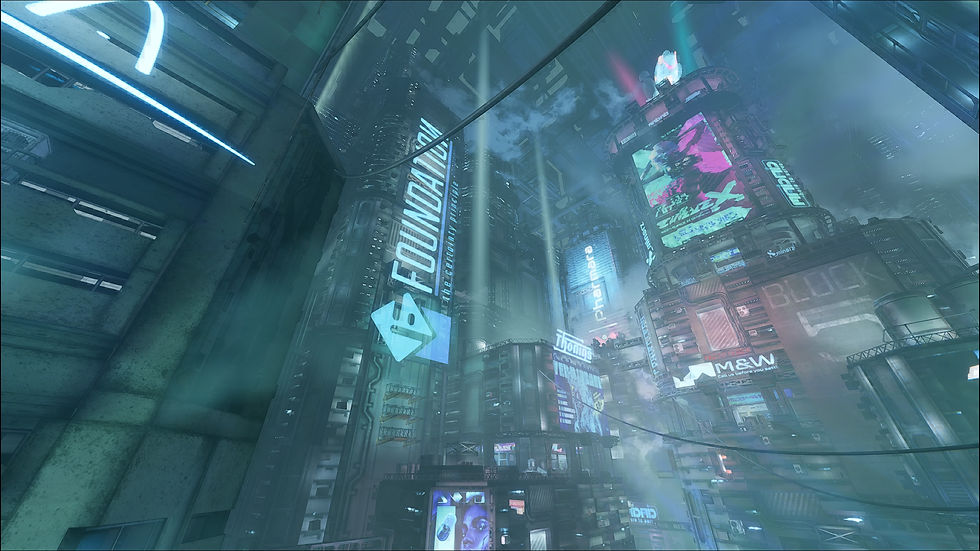
The 1st Ghostrunner was a visually striking game, and the second also has great art direction. An array of colors for you to gaze upon as you navigate Dharma Tower. Showing the many comforts and distractions people surround themselves with to deny what lies underneath. Crime, decay, and destruction as you make your way to these sectors. As the colors fade away and you’re then surrounded by darkness. At some point you go to the outside world, and it’s exactly what I had expected. Something I wished Cyberpunk 2077 would’ve let the player do more of. See the result of advancement and abusing technology. What life is out there is either inhuman or a being you cannot truly comprehend. The narrative of Ghostrunner 2 was a lot better this time around. It’s not a superb narrative, but much like I said earlier there is an attempt to build a better connection with the player and the cast. Jack is often questioned on what he plans to do after all is said and done. If all that he can truly do is kill. At one point he’s asked what his interests are. His favorite movie and whether he watches anything. The first game is about Jack’s individuality, and now it is about what he wants. What he dreams of. The main story is basic, but the characters and their writing are better. There’s only a few more compliments and critiques I had to offer.
The boss fights are better than the first game, or at least in my opinion. A good chunk of ‘em are opponents of equal size and skill than you. I say that, but the second to last boss is a dude who is hopping around. Summoning zombie robots and firing everywhere with an arm cannon. Contrast to the original where the first boss is a giant room where you gotta dodge lasers, strike certain points, and continue moving upward. Ghostrunner 2 did what Blasphemous 2 did in that rather than have thematic boss fights it goes for this order of warriors similar to you. However, I like fights like these and just because they’re a dude of your size doesn’t mean they can’t test your mechanics in interesting ways. There’s a wingsuit introduced late into the game, and by late I mean the second to last mission. Getting used to it was hard, but using it when the game pushes your pedal to the medal with the hardest combat sections in the game is even worse. This is also the second longest level in the game for me. I like how the intro and ending have these drawn cutscenes with stylistic artwork. Feels right for a cyberpunk game when most of the genre was influenced by anime. Overall I’d say Ghostrunner 2 is a good game, great even! It has its fair share of problems, but it’s a strong follow-up that listens to feedback and builds up in interesting ways. It’s not going to be for everyone just like the first Ghostrunner, but if you’re in the right mood and want something unique this is definitely that. A mostly well made action platformer. In the end I give Ghostrunner 2 an 8.5/10 for pretty good.


Comments