

A Plague Tale: Requiem
- Review On

- Jan 14
- 15 min read

In my previous review I discussed how four years ago my younger self wrote off a lot of video games for being alright. Games I enjoyed, but didn’t love the same way a majority of people do. Which is fine, because we’re human and we’re allowed to have our own subjective opinions. I treat my older reviews as records rather than posts I expect to continuously perform well. This whole website is an archive of my gaming experiences and growing up video games. It’s nice to see how my opinions changed then and now. To see how I’ve grown not just as a gamer, but as a writer who can critically look at art and workout components. Spider-Man is what we discussed last time, and this time we’re talking about A Plague Tale. The stealth action adventure series by Double A game developer Asobo Studio. One of few French game developers I know that isn’t Sanderfall Interactive who put out the award winning Clair Obscur: Expedition 33. Who would have known!? Anyways, Asobo is a really interesting studio in that before A Plague Tale they mostly made licensed video games. The shovelware kind before licensed video games started to become good. They got tossed around until they decided to go pseudo-indie.
Teaming up with Focus Home Interactive to create their first big title aside from all the rubbish they had made before. A Plague Tale: Innocence was one of the biggest surprises of 2019. It took heavy inspiration from The Last of Us and Brothers: A Tale of Two Sons, and asked what would happen if a near apocalyptic event were to take place back then rather than in the modern day. It wondered how people of that time period would react, and just how similar would it be to folks of today. It was not only an interesting exploration of an alternative unique apocalypse, but also attempted to explore themes of childhood. Following a young girl living a peaceful life and then being forcefully stripped away of it. Thrown into a world full of cruelty, sickness, famine, war, and death all while a small child is tugging at her shoulder. It talks about young children stripped away of their family and guardian figures. The burdens that weigh on their shoulders, and what they end up having to do to survive. I am very grateful to have two parents who can provide and care for me as modern times get harder. I feel bad for those who don’t have caring parents. Who are kicked out of their homes, or just never had a guardian to look after them. A Plague Tale was a game that tried to explore this, and for the most part I think they did a pretty good job. I think that A Plague Tale: Innocence is cool, and I wish I understood more in the past.
Compared to Spider-Man where I stated an opinion that aged poorly and felt out of nowhere, my opinion(s) for A Plague Tale: Innocence are pretty understandable in retrospect. I liked the story up until the big fantastical plot twist. A point I felt the game went from being weird but tame to fully embracing the weird factor. The gameplay systems are good, but if you’re pretty into stealth games like Dishonored or Metal Gear Solid 5 you’ll find A Plague Tale to be rather restrictive in what you do to solve any given problem. It was a very beautiful looking game, but it didn’t have enough environmental variety from my memory. A Plague Tale: Innocence was different. It was unlike any third person action game I’ve played before like God of War or Uncharted. It was this weird blend of action, survival horror, and stealth and it all culminated to form an experience in that the highs were high and the lows were just alright. I think I’m more warmed up to it now as there really is no other game I can think that is like it. Again, I can still understand why I felt the way I did in 2020 when I initially played the game. I wasn’t crazy for A Plague Tale in the same way a ton of people were, and when its sequel Requiem got revealed a few months later I wasn’t all too excited. I knew it was going to be a good game and hoped it would please the fans, but my alright view of the first game wasn’t enough to see Requiem as a future must play.
Later in 2022, A Plague Tale: Requiem released and its reception was just about what I expected. The game received the same level of love the first game did. Almost exactly the same level. It’s one of those video game sequels where both the opinions of whether you liked it more or not is understandable. So I was very surprised to see when A Plague Tale: Requiem got nominated for Game of The Year in 2022. Each year I feel like there’s an oddball choice, and Requiem was it for me. Stray was the game I think least deserved to be there seeing how there’s plenty of other indie games more interesting than it, but A Plague Tale: Requiem stood out to me for just being there. How good of a sequel was A Plague Tale: Requiem to be nominated for the category? I’ve always wondered, but I never got around to it due to what I said earlier. This year I plan to finish up a series I haven’t finished before, and what better choice next than A Plague Tale? That and they announced the third game last year, so what a perfect time to step back into the rat filled universe. I spent the last few days playing Requiem, and after my fifteen hour playthrough I can safely claim the game is really good. Much better than what I thought leading in.
To follow up on it being “one of those video game sequels”, I fall into the camp of players who liked it more than the original. I think it’s a much better video game in certain ways, the story hit me emotionally in a way I wasn’t expecting, and there’s more variation in where the journey will take you compared to what occurred in A Plague Tale: Innocence. That is not to say this game is perfect. I don’t think it fixed some of the mistakes Innocence made, and at times certain sections drag on a bit. This is a much longer game than Innocence and a common complaint I hear is that Requiem is bloated. Personally I disagree, and I want to express why I enjoyed Requiem so much even when the tough got going at times. I’m happy to have finally tried A Plague Tale: Requiem, and today we’ll be talking about why this nearly four year old game deserves your attention.
Story

The game takes place months after the events of Innocence. Our protagonist Amicia de Rune and her little brother Hugo discovered their mother wasn’t brutally killed and to save her. Both were assisted by Lucas, former apprentice of a grand alchemist before he was killed. Lucas decided to travel with the group and help escort them to safety while continuing his lessons under the eyes of Amicia’s mother. Their travels go pretty smoothly at first. Driving a wagon along fresh greens of the countryside, and waving to passing farmers and travelers. During their travels they stop to rest, replenish on food, and ask for guidance on where to go. Amicia’s mother states that a group known as the Order are willing to take them in. Offer a new home for which they can settle down and start their lives anew. No more having to run from men who want Hugo’s power or wish to kill them. I forgot to mention that in the last game the plot twist was that Hugo has the magical power to control rats. Infected with a mysterious disease since birth called the Magula, and is the only person in the world with it. Amicia is doing the best she can to look after Hugo, keep him calm, and prevent the Magula from becoming worse. As she learned previously the giant swarms of man eating rats that flooded cities were caused by Hugo’s stress rage.
The group are traveling to a new town to settle down, and along the way Amicia and Hugo end up accidentally running into a group of crazy angry men. They attempt to attack Amicia but just before they can end their life Hugo uses his rat powers. Killing the men and causing his disease to get worse. The family eventually reaches town and realizes the Magula isn’t settling down. It is inflaming and sends Hugo into pain. Amicia and Lucas attempt to get Hugo help, but the more they do so the more things get worse. The new city they settled down in are eventually infested with rats more than anything they’ve seen before. Buildings crumble, the ground shakes and split into two, and the once humble streets transform into a warzone. The family narrowly escape and decide to venture out to find another town who can help Hugo. More members of the Order who understand the Magula, but Amicia doesn’t think this is the right choice. Hugo one day dreams of an island far away from their homeland. The island contains a special pond which can heal his condition, and he believes it’s real. Amicia slowly begins to think Hugo is right, and decides to help him venture towards this island. Straying away from their mother and navigating all new dangerous lands on their own. Encountering new enemies, mysteries lying beneath the surface, making unlikely allies, and seeing if she has the strength to protect those close to her. She will fight endlessly even if every bone in her body breaks, her mind torn into two.
Gameplay
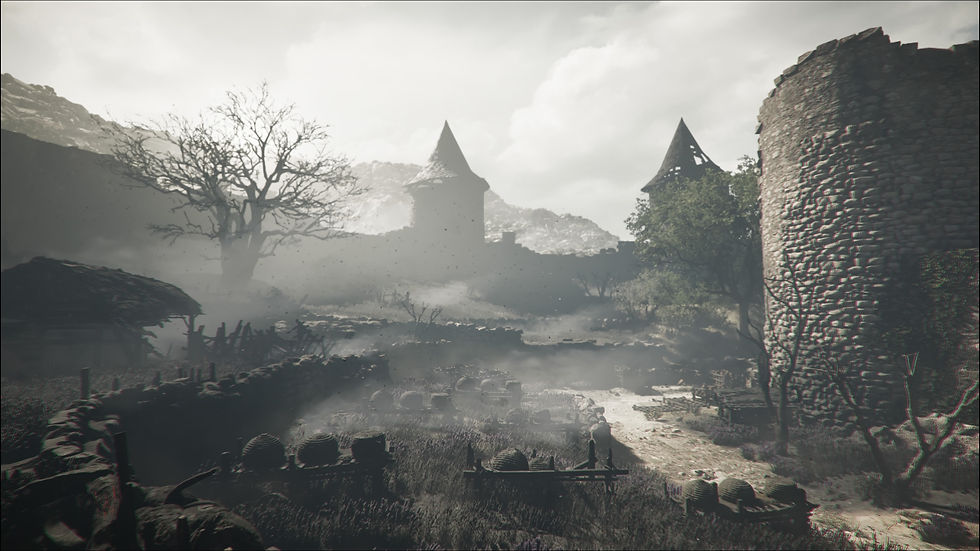
This game is a mixture of action, puzzle solving, survival horror mechanics, and mostly a stealth experience. I can’t say it’s strictly one or the other, which is why I opened up this review saying A Plague Tale is one of the more unique third person adventure games I’ve played. The puzzles are quite simple and are designed similarly to ones you’d see in the Uncharted games. Push over a cart to climb a ledge, or open up a way forward. The most interesting puzzle set piece is when you’re surrounded by rats. A sea of little creatures that’ll kill you instantly if you let them swarm around you for a few seconds. Oftentimes you need to find a way around the rats, and fire often is your most useful tool. Lightsources push away rats and you’ll be using them to create them. Ignite candles, lanterns, and use torches/sticks you pick to create temporary portable lightsources to cross through the rat horde. You unlock a good surmount of alchemy recipes throughout your journey and this is where the survival horror aspect comes to play. Your main method of defense is a sling. It needs to be prepped up and aimed before it can launch a rock, which you have an infinite amount of. You can dip your rocks in chemicals you concoct using materials, but you only have so much as resources are scarce and you can only carry so much at a time.
Use an igniter for what its name simply describes. Create a pool of tar and combined with your igniter it can create personally made lightsources on the fly. Use a chemical that can specifically lure rats for a short period of time. Throw an extinguisher to put out the fire. That last one may seem a bit useless, but wait until you’re thrown up against some guards. A Plague Tale manages to use what are most ordinary individuals in medieval times and turn them into the deadliest force you will face. Guards can kill you instantly if you’re not careful. One strike will weaken Amicia, but if they slash at you again before Amicia can recover it’s instant death. Again, stealth is the most useful procedure when dealing with guards. Use tall grass, high wall cover, and even tables with big enough space beneath them to get by guards. The guards have different awareness levels when spotting you. If they see you they’ll stare for a bit. If they notice something is wrong they’ll move towards your position. If they manage to lose sight of you but still think things are not what they seem they may raise awareness with other guards. If they fully spot you they will start to pursue you. Maybe even alert surrounding guards to assist them in their pursuit.
You can defend yourself in a multitude of ways, but it requires using resources you’re limited in. If a guard is not wearing headgear you can kill them instantly with a well aimed rock sling. More often than not they will be wearing headgear, which creates interesting situations. If headstrikes won’t kill them then what will? How about using the environment to your advantage. Sometimes you’ll be surrounded with guards and rats at the same time, and rats can devour enemies at the same rate they devour you. Putting out light sources near guards will send rats to them instantly. You could ignite an explosive near a guard to set them ablaze. Force a sack of powder to burst to stun the guards for a short period of time. Later on in the game you unlock the ability to control rats with Hugo, but time with it is limited as when Hugo is fully stressed out you can’t use them anymore. Hugo is also your method of detecting enemies surrounding you, so keep that in mind. The rock sling and concoctions are your most basic tools, but they are not your only useful tools. You have a crossbow that can kill enemies instantly, and pots which can create a distraction or a pool of whatever concoction you put into them. Both crossbow bolts and pots are hard to come by, so use them if there really is no other choice when dealing with a problem.
New to A Plague Tale: Requiem is the upgrade system. I forgot if Innocence had any upgrades to speak of, but Requiem allows you to upgrade tools and abilities to slightly expand how you deal with future situations. Tools are upgraded at workbenches using the resources you pick up. That is why it’s important to be on the lookout for chests and secrets containing what you need. They may expand your resource pouch space, make the sling strong, etc. Character skills are different in that they level up the more you do a specific kind of playstyle. If you sneak more without ever being detected you increase stealth. If you kill more enemies you increase combat skills. If you use your concoctions and the environment often you increase your skills in opportunity. They are represented with bars in a menu screen, and the higher they go the more you unlock skills in one of three skill sets. This is honestly pretty cool, and while not original it works well for a linear story adventure game. Aside from that there’s not much else for me to say. Let’s just hope your effort is enough to protect the young sorry soul beside you.
Thoughts

I think A Plague Tale: Requiem is a really good game. It’s a strong follow-up to the original and I’d argue it’s a much better video game. Even if the story is longer and there are more cutscenes. Recently I have been thinking about the Uncharted games, and how despite not being perfect or complex video games they’re still great. They’re fun linear adventures that do exactly what they want and end when they think it’s right to. Josh Strife Hayes made a recent statement about this saying a game that gives you exactly what it says it wants to give you is often the best. I’ve been thinking about these types of games for a bit, and that’s a reason why I chose to go back to one of these games despite them not being my favorites. A Plague Tale: Requiem is exactly what it said it wanted to be. A linear story driven action adventure that doesn’t go on for more than fifteen or so hours. I love RPGs and open worlds, but I don’t want every game to be one of the two. There are times when a compact game is better than a big one, so that’s another reason I enjoyed this more than I hoped. I was in the mood for one of these games, got it, and was pleased.
So is this game good on its own? Well yeah obviously. We wouldn’t be talking about it if I didn’t have more than five things to say. A big difference I noticed upon playing Requiem is that it is a lot harder than Innocence. They expanded the mechanics and toolkit quite a bit, and to balance the new changes they made encounters more difficult and enemies more aggressive. Diving deep into the stealth genre has made me further appreciate how enemy AI is designed in these games. Their different awareness states, what they do to hunt the player, and calling help if needed. It’s not the most advanced AI ever and you can certainly take advantage of it if you know what you’re doing, but it’s impressive as always to see what it is capable of. My main critique and this is mainly a skill issue critique is that enemies spot you too quickly. I like stealth games, but I’m not the best at them. Even with a third person camera you need a lot of sensual awareness, which explains why they gave you the new ability to sense enemies from afar and behind walls. They can spot you in less than five seconds if you are not careful and trying to hide from them is quite difficult. This isn’t Metal Gear Solid, Hitman, or Dishonored where you can hide in a closet or quickly transport yourself to safety. More often than not you will be wide in the open and have to make due with what you have. However, as much as I complain about the difficulty I do think it is a good thing. It’s a good thing seeing a game challenge you in stealth the same way as it does with combat. It makes getting through these tricky stealth sections rewarding.
Earlier I stated A Plague Tale has puzzle elements. The type you find in an Uncharted and while I can see people complaining it affects the runtime and replay value I argue for them. It breaks up the pacing so you don’t get too much of either world. Even outside of designated puzzle sections I still found myself thinking like it is a puzzle game. That’s because of how the game handles the player’s resource management and windows of opportunity. You can only craft & carry so much, and there’s only so much of a resource you’ll find during your travels. So resource usage was a careful consideration. The crossbow is your last minute defense, but bolts are rare and unlike the chemicals you can’t craft more of them. It makes finding another bolt more exciting, because it means having a few more opportunities to escape danger. The same goes for claypots, because you can’t carry too many of them and they are incredibly useful for creating temporary pools of what you need. My favorite resource in Requiem is probably the knife which I mentioned earlier. The knife is incredibly useful as it allows you to kill an enemy instantly if they get too close. It is a one time use, and there’s usually only one hidden in certain chapters. However, if you save up the knife you can use it to open up specific chests that can only be budged open with a knife. The chest often contains resources to upgrade your tools, forge stronger concoctions, and tables to then upgrade your tools. Making the player choose on whether to save a knife or not is clever. It is a great way of combining survival horror with linearity.
Near the end of the game there are a handful of forced combat sections. Parts where they ditch a focus on stealth and resource management by having you fight a wave of enemies while being given a good amount of supplies. I don’t mind these sections, because they’re not only placed at a point to show how far the player has come on their journey but they match the main themes of the story. The main story is a wild ride much like the second half of Innocence, but one last touch before we close the review with a short story discussion. This game is beautiful both visually and in terms of art direction. I don’t remember much of Innocence because it’s been almost five years since I played it, but I remember it being a really dark game. It was graphically beautiful, but it was drab and depressing. Which makes sense for the tone and themes, but I prefer color in my video games. Requiem is a more colorful game, and it makes sense for what it’s trying to do. It is trying to be a grand new journey to unexplored lands. Places far away from home and you are unfamiliar with. An adventure to realms you thought were myth. It does still have an occasional dark drab moment, but it pulls them out at the right time. Usually moments of chaos and decay. The moments when everything has gone to hell.
The story of Requiem is heartbreaking and in a good way. Innocence was about Amicia forced to live and adapt in a cruel world, and Requiem further explores this by showing how fierce Amicia is willing to become to protect those close to her. She starts killing more mercilessly. Without a sign of regret on her face, and the choice to do so comes back to bite her. As her brother who is still young and learning how the world works thinks this is the right thing to do. This is the right way to judge those who wish to harm you. He begins using his powers to hurt others, and Amicia as well as the surrounding cast question her influence on Hugo. Wondering what she taught this kid, and if either of them are good individuals. Are they truly saving the world, or only doing it to get what they want? It coincides well with the game’s main message. Of what it means to be the guardian of a child. The sacrifices you have to make and hoping by the end it’s worth it. For a lot of people it is, but Requiem explores the idea of it not being so. A child who is destined to die at a young age. There being nothing you can do to stop their inevitable death. Watching that child crumble before you, and wondering if there’s a possibility to end their suffering. Either through a cure or putting them out of their misery yourself. The second sadly being the harder option as it’s something you have to consciously choose. An act you must carry out in your own hands. The main message further being elevated with Amicia’s fear of ending up alone. Of losing more of her family and having nothing left while the world eats her up. Requiem is a game about loss. It is about watching a loved one die and how you’ll cope with it afterwards. The story is the reason why I stuck with this game despite it's flaws.
I’m more of a gameplay guy. I always make sure chunks of reviews break down the design, but I always think games deserve good writing. They deserve to test our morals, keep us hooked, and remind us what it means to be human. To understand those going through a specific situation and empathize with them. A Plague Tale: Requiem is a game aiming to be a weird and emotional experience, and all these years later I have finally accepted what it is. In the end I am gonna have to give A Plague Tale: Requiem a 9/10 for excellence at best.


Comments